|
|
Surrender
Album
Marina Alessio: lead vocals. Ulises Conti: piano, electric guitar, cello, castanets, noise machine. Juan Tobal: farfisa, bass, vibraphone. Agustín della Croce: cello, electric guitar, synths. Ezequiel Cutaia: organ. Mariano Malamud: viola, organ. Martín Feldman: drums, rhythm machine. Dylan Elliff: percussions. Pablo Puntoriero: tenor saxophone. David Alonso Fernández: trombone. Backing vocals: Marina Alessio, Ulises Conti, Juan Tobal, Martín Feldman.
Recording engineers: Agustín della Croce, Juan Tobal, Dylan Elliff, Ulises Conti. Mixing engineer: Agustín della Croce. Mastering engineer: Agustín della Croce. Studios: La orquesta de cristal, Voyager Estudio.
Musical production: Ulises Conti and Juan Tobal. Executive production: Marina Alessio and Ulises Conti. General production: Ulises Conti.
Composed by Alan Vega and Martin Rev. Arrangements and recomposition: Marina Alessio and Ulises Conti.
Cover art: Marina Alessio. Graphic design: Martín Feldman.
Published by Metamusica. Buenos Aires, Argentina. 2025.
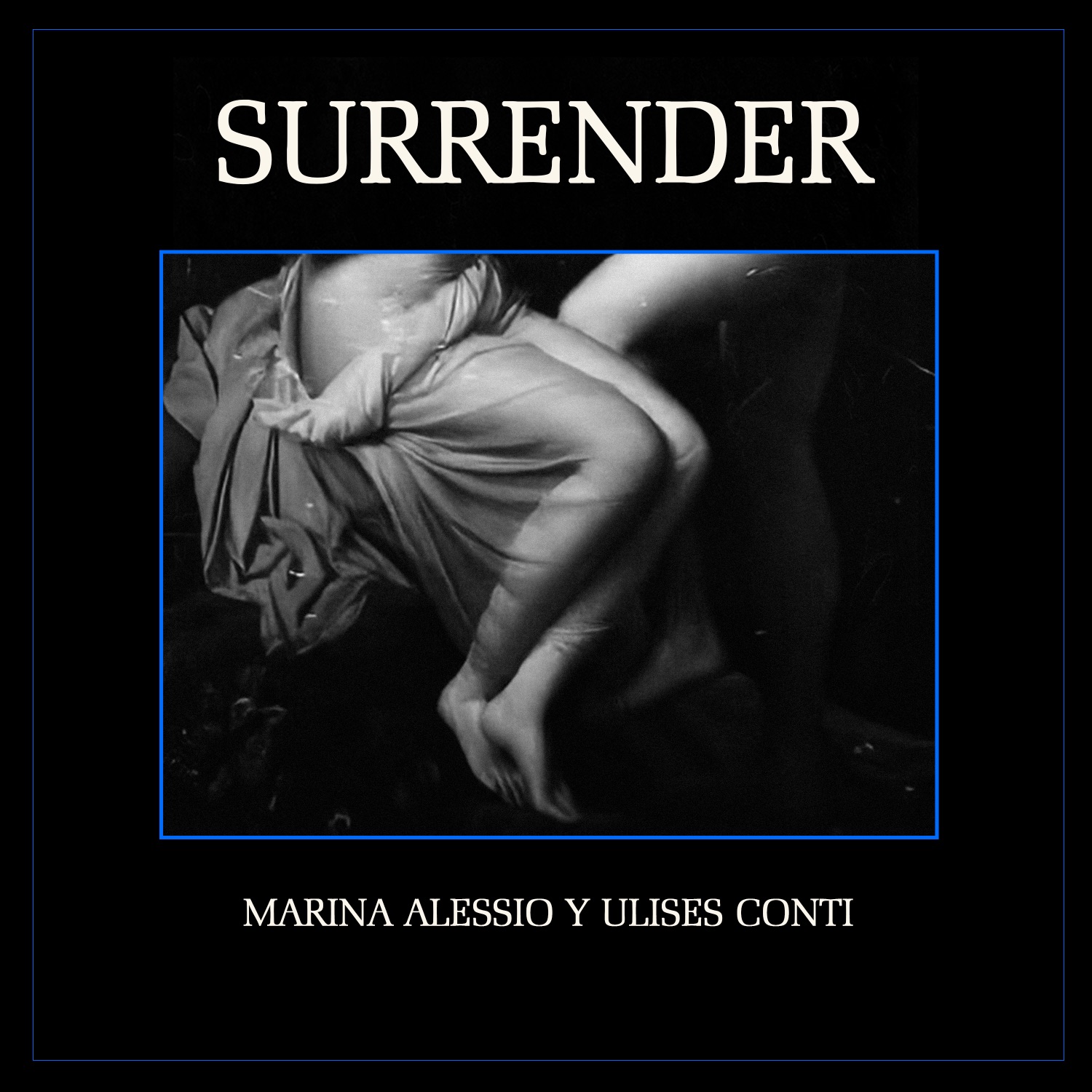
First album in collaboration between Marina Alessio and Ulises Conti. This is the recording debut of a duo that has been working for more than fifteen years on anonymous and secret projects across different disciplines. This time, they break the silence with their first LP, Surrender. It's an extended recomposition of the song «Surrender», originally composed by the legendary duo Suicide —formed by Alan Vega and Martin Rev— and released in 1988. «Surrender» is reworked with an orchestral arrangement that is both unusual and bold. The original song, whose duration is 3:47 minutes, expands to 33:00 minutes (the duration of an LP), going through different musical moods and transforming a song into an album. The vocals, which begin in the foreground, guide us during the entire work through different sceneries and emotions, telling a story and its every variation, as it degrades and fades, ending up hidden behind the multiple layers of sound that make up this work, reaching a climax where the vocals come to the forefront again, this time accompanied by a choir. It is not about a formalist exercise; it's a journey through different musical moods, whose intention isn't to directly reference Suicide, but rather the band's own references. At the same time, the photo for the album cover was taken with a digital camera pointed at a phone screen showing a reproduction of the painting Cupid and Psyche by François Gérard (1798), an artwork inspired by the mythology of Apuleius. Just like on the album, the camera's flash picks up the glass reflection from the damaged phone screen, adding noise layers that degrade the colorful texture of the original image. In both cases, Gérard's painting, as well as Suicide's song, transforms into a new artwork. |
||